
Vocationalisation of School Education
Vocational education aims to develop students’ skills and make them economically self reliant by linking education and jobs. Practical work and training are very important components of Vocational Education. The vocationalisation of education in Kerala ensures the “Work integrated learning at the early ages in middle classes and the quality vocational education at higher secondary classes”. At lower classes, it aims to develop positive work culture & dignity of labour and the pre-vocational skills at slightly higher classes. National Skill Qualification Framework (NSQF) is introduced at higher secondary classes with Level 3/ 4 Job roles. It allows students to gain practical experience in their chosen career path before they even graduate. Vocational Education being an integral part of general education system in Kerala at Secondary and Higher Secondary level aims to enhance the employability of youth.
Non Recurring and Recurring Expenses
For ensuring quality vocational education, the infrastructure facilities, machineries, tools and consumables should be purchased and maintained in schools. The consumables are to be recouped and the wear and tear of the system to be addressed. There came the necessity of Non- recurring expenses in new schools and recurring expenses in the existing schools. The upgradation of instruments and machineries are also important. There came the necessity of Non recurring expenses in new schools and Recurring expenses in the existing schools. As a matter of ensuring quality vocational education, the tools and equipments were ensured and the necessary raw materialist were set in vocational labs. The details of recurring and Non-recurring expenses during the year 2023-24 under various titles are as below: Non recurring expenses for new schools. Furniture, tools and equipments were purchased in 8 New schools based on the store purchase rule prevailing in the State. Standard lists of tools and equipments for each job role based on the curricula of PSSCIVE/ Sector Skill Councils (SSCs) were made available by the SCERT Kerala after the approval of Expert committee. Based on this Standard lists, the Non recurring materials were purchased in schools. Recurring expenses for the existing schools. Existing 253 schools had expenses on raw material, maintenance of tools & equipments, office expenses /contingencies. These were the main heads of recurring expenses. The present gaps of the tools & equipments, raw materials, office expenses/ contingencies were identified in schools with the help of Department of General Education and then the cost were estimated. Based on the requirements, funds were given to these schools. Vocational labs were fully equipped, trainers were skilled and updated on the recent technological equipment. The learners were provided quality skill training.
Assessment and Certification
Assessments by third party agencies for second year students of 394 NSQF batches were done by the Sector Skill Councils (SSCs). Prior to the assessment process, there was a comprehensive discussion with National Skill Development Corporation (NSDC) leading to this framing of regulations and the agreement format which were later signed with the SSCs. Based up on the agreements signed between the Director of General Education, Kerala and various SSCs, assessments were conducted according to the schedule framed jointly by the Examination wing of General Education and SSCs. The students were awarded the skill certificates as per the National Skill Qualification Framework (NSQF).Training Partnership with Industries in NSQF Schools.
Industrial Training is a doorway for aspirants to achieve their professional goals by allowing them to obtain in-depth understanding of their theoretical curriculum while also allowing them to watch and gain personal experience of the industry, job execution and work environment. Success of vocational education primarily depends on the degree of its meticulous interaction with industries. Experiential learning is the foundation on which the skill acquisition is fostered and the quantum of the same reciprocates with the advancement in industrial infrastructure and the expertise of which in turn should progress in tandem. NSQF in Kerala attributes this genre of skill acquisition during the academic year 2023-24. Learning by doing is the hallmark of this system and the success of the same lies in the covalence of bonding between industry and learning. To enhance the same, industry partnership is inevitable. The NSQF implementation in the State during the year 2023-24 was done by ensuring a meaningful partnership with relevant industries by way of continuous interaction with all stakeholders of the skilling ecosystem. Skill acquisition through experiential learning and personal experience in industries was meant through partnership with industries. Expert Interactions Experts from the industries interacted 5 times (separately for first and second year batches) based on the schedules prepared by NSQF Cell of Department of General Education (VHSE Wing). Students interacted with the industry experts for their career development. They could clarify their doubts and accurate information on latest trends.
Field Visits
Field visits were conducted at various industry premises with the help of industry coordinators at concerned industries. 2 such visits were conducted under the leadership of industry coordinators. The queries from the students were addressed and replied by the industry experts. All these activities provided hands on real life experiences to the students and they could expand their knowledge by having an in-depth industrial experience. Training to Trainers Trainers’ training is inevitable since the training up-skills the trainer to the current requirement level. The innovation in industrial sector should outreach the trainer on time so that it may uplift the competency of the trainer concerned. Trainers Up-skilling programs of different job roles were held at industries with the partnership of different industries in different timing. 10 days Induction Training for newly recruited teachers and 5 days In-Service Training for existing teachers were included in this programme.
On the Job Training to Students
Familiarising the industrial climate and acquiring skill from the real field, the students get a confidence in his vocation. For this, effective On-the-Job Training (OJT) programme should be implemented. 80 hours (instructed by PSSCIVE) of On the Job Training (OJT) were given to second year students. These trainings were designed and developed by various industries concerned. Modules for the OJT were developed by Institute Industry Interaction Cell of Department of General Education (VHSE Wing). The schedules of the programs were finalized after consultation with the school teachers concerned. In order to enable students to cope with industrial cultural and exposure and real working environment OJT was given. Employability skills among students could be developed as a matter of providing OJT to Students.
Hub & Spoke Model
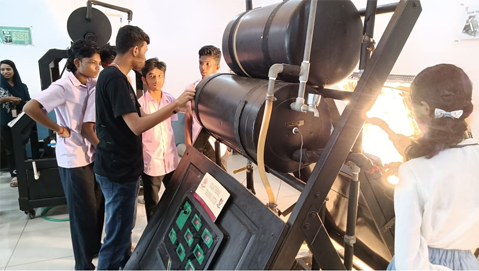
Different Vocational activities held in Hub Schools were conducted by vocational trainers with the support of local experts. The selected students from Hub and Spoke Schools were the beneficiaries. The programmme was implemented on a pilot basis in 14 Hub schools in the State. Basic Vocational Skills in Modern ad traditional agricultural practices (Hydroponics), Household plumbing operations, Household electrical works and repairing, Day to day Electronics, Two Wheeler servicing, Cooking and Family budgeting. Apart from this, they could develop different life skills like Problem solving, Critical thinking, Communication and interpersonal relationship, Decision making, Creative thinking, Self awareness, etc. were imparted in the camps. One Vocational Higher Secondary School in each District was selected as Hub school. A nearby secondary school was selected as Spoke school (near to hub school selected). 60 High School Students from each Spoke school were selected for 5 days camp activities. Hub school’s lab facilities were utilized for different activities conducted of the camp. 5 days training programme on agriculture, electronics, plumbing , budgeting , automobile service etc are given with the help of local experts, Vocational teachers, Instructors, Trainers etc. Participation of local people, representatives of local self governments was ensured for planning and for the conduct of the camp. The 5 day camp in the Hub and spoke school was meant to provide an exposure to the various aspects of different vocations to students. Students familiarized the basic skills on various agricultural practices and household electronics services. Their interpersonal skill and communication skill improved much better. Students acquainted skills in plumbing and electrical repairing. The camp improved their creativity, self confidence and decision making ability. They got deep insight in family budgeting and energy conservation methods.
Skill Share ‘23
Vocational learning opportunities play a critical role in skill development and employability. The importance of vocational development can largely be summed up as the difference between theoretical knowledge vs. practical skills. In non-vocational studies, students often spend hours of their time exploring a variety of different subjects Project-based learning significantly improved students’ learning outcomes and positively contributed to academic achievement, affective attitudes, and thinking skills, especially academic achievement. Vocational training within schools aims to make students career-ready by providing them with real-time, practical experiences in their chosen sectors. The overarching objective is to ensure students are poised for employment upon graduation. The National Education Policy (NEP 2020) underscores various reasons for integrating vocational training within the traditional academic framework. Students were given an opportunity to serve the community through the job roles they have theorised in their classrooms. Student community turned out to be socially committed individuals as a result of the project.
INNOVET
SSK introduced a new innovative programme INNOVET (Innovation in Vocational Education and Training) for students in the vocational stream. The programme equipped learners ready for manual activities related to a specific trade, occupation or vocation. The main objective of the programme was to promote innovation in students in their vocational stream and to create an interest among students in their domain of vocational area in which they belong. The programme was implemented as 2 days training camp at selected centres in each district across the state. The enrichment of entrepreneurial skills, development of higher order thinking skills such as problem solving, critical thinking. Decision making and creative thinking were the outcomes of the programme.