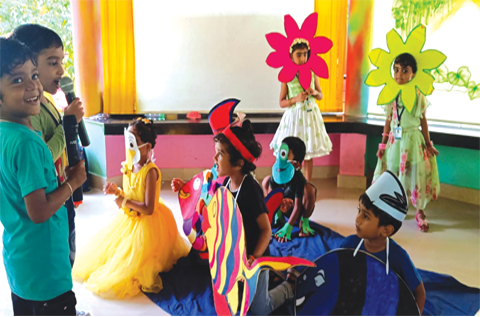

Anganawadis and pre-schools need to go hand in hand. Theme based approach is followed both in anganwadis and pre-schools. 3+ and 4+ children of both Anganwadis and pre-schools have to undergo similar experiences for their development. Hence it becomes necessary that the themes need to be unified. Both the Anganwadi workers and Pre-primary teachers have to be trained in the learning strategies and activities that is to be implemented in the classroom. For that a cluster of 3 Anganwadis and a pre-school was formed. A package of activities was developed for them. Material development workshops and periodic training for ECCE teachers were conducted. Through this programme joyful learning for children in the activity corner became a reality. Empowered teachers in the strategies of child development and sound knowledge for teachers in child psychology was made possible.
BALA is about developing the school’s entire physical environment as a learning aid – the inside, the outside, the semi-open spaces – every where. At the core, it is about maximizing the educational ‘value’ of a built space. It is based on ‘how children learn’. BALA is a way to holistically plan and use the school infrastructure. It incorporates the ideas of activity based learning, child friendliness and inclusive education for children with special needs (CWSN).Building as a Learning Aid (BALA) aims to use the built elements like the floor, walls, pillars, staircases, windows, doors, ceilings, fans, trees, flowers, or even rainwater falling on the building as learning resource. In this way pre-primary classrooms were provided with attractive and colourful furniture created child friendly atmosphere in all pre-schools. Children became active participants in the leaning process. This helped to create inclusive learning spaces and provisions/ spaces for Children With Special Needs (CWSN). Child friendly furniture inspired children’s creativity, learning and created conductive self-learning situation for children.
Child friendly Furniture Preschool furniture plays an important role in the learning environment. Preschool furniture acts as learning tools for children. Giving children proper preschool furniture and making them learn discipline to sit, pose, act and behave with those will eventually promote their growth. Well-designed preschool furniture gives children the freedom to study and understand shapes, sizes and colours. This helps for mental growth. Incorporating child-sized furniture in to the learning environment will give children more access to learning materials and more opportunities to explore their environment. Using child-sized furniture will also help children build self-confidence and become more independent, which is important for their overall growth. Guidelines were prepared and designs were familiarised in the state level. Orientation classes were conducted for head teachers and SMC Chairman. Classrooms were equipped with child friendly and eco-friendly furniture. It ensured physical and mental well being of the child. Child friendly furniture inspired children’s creatively and learning.
Outdoor play materials for Pre-schools is so important for the sensory needs and development of Pre-school children. Outdoor play equipments are not only designed to be safe and fun to use – it is formulated to help the child develop mentally and physically too. Outdoor play and brain development are so closely tied together. Outdoor play also encourages a social atmosphere where children can learn patience, learn to share and learn to observe those around them. Play materials have a positive impact on children to learn and explore the world with a rich imagination in a joyful way. It made children physically and mentally active in a material learning environment. For that guidelines were circulated and oriented head teachers and SMC. Installed outdoor play equipments and monitored in pre schools. It ensured the physical development for pre-school children and thereby increased creativity, learning abilities, social interaction and collaboration. Social skills, spatial awareness, co-operation communication and sensory awareness developed in students.
TLM for Children Teaching and learning materials are crucial to any successful teaching and learning process. These resources aid the teacher to effectively transfer the content to the preschool learner. These materials tend to assist children to open up in many areas which lead to holistic learning. When children are exposed to various teaching and learning resources, they tend to be active and involved in the learning process. Kalippattam, Kalithoni reading cards, activity books etc. play a vital role in the holistic development of preparing children. It enriched the activity corners and made learning joyful. This aimed at the holistic development of children. Effective communication is possible through this TLMs. Three volumes of activity cards were printed and distributed. For getting, effective support, parental orientation was organised. Public exhibitions of students’ products were arranged. It ensured the holistic development of children.
Pre-school Festivals (Incorporating Celebrations in Early Childhood Education) Celebrations are among the most important binding factors in any community or society. In Pre schools too, celebrations can be a great way to nurture a sense of being and belonging in children, when planned and implemented with sensitivity and reflection. Parents and teachers have the responsibility of not only making sure that the preschool kids enjoy every festival but learn as many things as possible from them. Festivals are not just mere celebrations of a day, they offer a lot of positives that can be a great influence on any child. It can ignite several moral values, and help them in differentiating between the good and the bad.
Kathayulsavam Kathayulsavam was one of the festivals planned by SSK with the aim of developing skills and abilities of primary students through telling stories. Story telling can be used as a strategy to help pre-school aged children acquire the development area and language skills they need to acquire. Kathayulsavam was a June-long activity for pre-school children that embraces the diverse possibilities of story telling. This helped to create a culture of story-telling and story reading at home and at school. District level residential training for 3 days was conducted. Later workshop for pre-school teachers and BRC members was also organised. Awareness campaign for parents was implemented Katholsavam was organised in schools. As a result of this reading culture was nurtured at school and at home and helped to make pre-primary education enjoyable. Children could develop the language skills. Language and performance spaces were activated. The teachers as well as students become an experts in story telling.
Varayulsavam Varayulsavam was a festival launched by SSK with the aim of making scientific pre school education experimental and enjoyable. It was organised through creative, environmental and lifestyle activities. It ensured the development of various skills of pre-primary students. Pre-school teachers and parents made aware of the possibilities of drawing area and scientific pre school approach. It encouraged children’s creativity and ensured experimental learning opportunities. Workshops for pre-school teachers were conducted and awareness campaign for parents was also organised. Drawing area and drawing materials were set up in the classroom and outside the classroom with the help of parents. Varayulsavam was organised in schools. Varayulsavam had been made an excellent activity for five sense development in children. It was possible to create an emotional connection with nature and inculcate values and attitudes of nature conservation and love for fellow creatures. Competencies related to language, mathematics and environmental studies were developed.
Attavum Pattum Attavum Pattum was organised to maximise the potential of songs, rhythms and movements for the comprehensive development of pre-school children. It ensured new learning experiences through songs and movements by utilizing the various spaces provided in pre-school classrooms. It helped to create joyful and creative learning experience for pre-school children. Workshops for pre-school teaches and awareness programmes for parents were organised. One day festival of music and movement was organised. A wide range of creative activities designed considering all areas of development of children. These activities helped to develop motor skills, improve language and listening abilities and to encourage self-expression and creativity. Music and movement also promoted a sense of rhythm, pattern recognition and social collaboration, laying a strong foundation of early learning. Rhythm Area Art and music are integral to a child’s holistic development, especially in the pre-school years. They nurture creativity, improve motor skills, boost language development and enhance social and emotional growth. Integrating art and music into pre-school learning allows children to express themselves freely, develop cognitive skills and explore the world through sensory experiences. A rhythm area is the school further complements this by enabling to engage with sound, movement and pattern and fostering love for music and rhythm. Teachers were given training to design different activities using the rhythm area promoting multiple intelligence in children. An amount of Rs.3000 was allocated to each school to set up the rhythm area, with simple instruments like drums, instruments made from kitchen utensils, coconut shell, discarded bottle filled with metal chips and PVC pipes. Children were allowed to explore and create their own beats and to mimic simple rhythms. They were also given nature and art integration activities. Children were provided with a multisensory experience that nurtures creativity, motor skills and social emotional development.