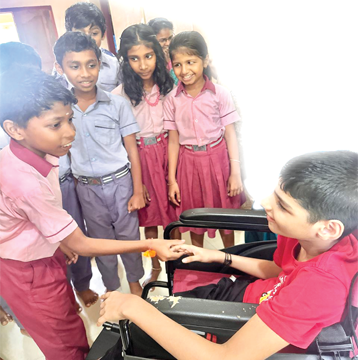

Inclusive Education s system of educating children with special needs along with their peer group in schools under general education. The vision of inclusive education is to provide quality education for Children with Special Needs (CWSN) irrespective of caste, creed, socio-economic and cultural differences.
Purchase / Development of Instructional and Training Materials
The purchase and development of Information and Communication Technology (ICT) related equipments such as tablets, laptops, etc. and Teaching Learning Material (TLM) for CWSN can greatly enhance learning opportunities and accommodate devise learning style and abilities. Objectives: Age appropriate instructional materials and Teaching Learning Materials (TLMs) should be developed for Pre-primary, Elementary and Secondary students to increase academic interest and understanding and thereby to raise the confidence level of the students. Achievements: The integration of ICT and TLMs fostered an inclusive learning environment where CWSN can actively participate alongside their peers which in turn reduced stigma by showcasing their abilities. The special educators and teachers have been equipped to manage diverse needs within the classroom.
Sports and Exposure Visit
Inclusive sports and games are designed to encourage fitness and well being of all participants while reducing stigma with disabilities. The CWSN students who are willing to participate are given special training in various sports events and games alongside other students. The special events are conducted in districts like Football matches, Cricket matches, swimming, cycling, etc. Exposure visit Beyond classroom experiences, differently abled children learn many things from exposure visits conducted to historically important places to make them more enthusiastic. Inclusion of CWSN students in sports and games events is intended to develop self confidence among the students, to make sports tracks and rules more friendly. There is also a possibility of socialisation and exposure to a new environment for the children. Achievements: CWSN could experience the new environment of sports and games and got a chance to mingle with outside the community as well.
Therapeutic Service
CWSN needs various kinds of services to meet their daily living needs and academic achievement. Objectives: The programme intends to equip the parents imparting various therapies like physiotherapy, speech therapy, occupational therapy and behaviour therapy and thereby improving the locomotor movement of the disabled children and enhancing their life skills. Outcome: Self confidence of the learners were enhanced as they could communicate better and socialisation is made easy. Speech and locomotors impairment and behaviour problems were minimised through continuous therapy.
Changathikoottam
This is an extensive programme that gives CWSN an opportunity to socialisation by gaming the support of peers and community. SPACE ensures school experiences for bedridden children. Objectives: The programmes aims to provide experience for bedridden children who suffer severe physical and mental disabilities and to create a positive attitude among them. Outcomes: Collaborated with organisations like Kudumbasree to find job training and marketing opportunities for parents of disabled children.
Escort Allowance enables all the differently abled children from Pre- primary to senior secondary to access school. Objectives: Aims to cater to the needs of CWSN who are economically backward and to provide an opportunity for normal schooling. Outcomes: The students could experience normal schooling.
Transport Allowance Sufficient fund is granted to ensure the access of CWSN. Objectives: The programme aims to cater the needs of economically backward CWSN. Outcome: With the functional assistance, the disabled students could reach the school without much difficulty.
Reader Allowance (only VI & Low vision) A reader should be engaged to help VI children experience textbooks, newspapers, magazines and library books. Grant is e-transferred to these beneficiaries. Objectives: The programme aims to develop the cognitive domain of the child. Outcomes: Reading experience was ensured to partially and fully blind students.
Girls stipend This provision is to encourage the participants of the girls with disabilities in the classroom activities. A stipend of Rs.200 per month is provided. Objectives: The scheme was introduced to maintain equity and equality. Outcomes: Access of disabled girls could be ensured.
Providing aids and appliances The assistive devices such as spectacles, hearing aids, orthopedic equipment and prosthetics appliances were distributed from Pre-primary to senior secondary prescribed in medical camp. Objectives: The programmes aims to descend physical difficulties by providing suitable equipment. Outcomes: The camp provided sound guidance and training for the children to use the device.
Braille Stationary Materials (Inc. Embossed charts, globes) Braille stationary materials help the class VI students to make learning easier and to fix the ideas using concrete objects, computer based adaptation and magnifying lens need to be provided as part of this project. Objectives: The programme aims to increase the confidence level of class VI students Outcomes: Class VI students could engage in the learning activities with increased level of confidence.
Assistive Devices, Equipment and TLM
This programme intended to purchase of assistive devices and equipment, development of Teaching Learning Materials. Children with disabilities in vision, hearing and locomotor will be benefitted with it. Magnifying lenses, software and mobile app should be provided for the visually impaired. Teachers should also be trained to facilitate the same. Sign language, lip reading and softwares should be introduced for the hearing impaired. TLM, video, familiarisation of web based instructional material, familiarisation of relevant online sites can be utilised for the intellectually disabled children. New trends in this field also should be familiarised to teachers, parents and special educators. Objectives: This programme aims to equip CWSN to suit the circumstances of the new world. Outcomes: Learners could overcome various obstacles in learning process.
Environment Building Programme Short Film Festival The society has a responsibility in the process of socialisation of differently abled children. To achieve the goal of making the society differently abled friendly, there needs to be a fundamental change in society’s attitude towards differently abled people. Different programmes are planned and implemented in the state to create awareness among general public about the rights of differently abled persons and to inculcate an attitude of caring for differently abled persons. Cinema is one of the powerful media selected to be conducted in all districts for public awareness. During 2023-24 year, Samagra Shiksha Kerala conducted a short film contest and a short film festival comprised of winning entries and other selected short films based on the topic related to such kind of message to the society. Objective: Film festival & Theatre Arts aims to instill a positive attitude in society towards the disabled people.
Social Inclusion Programme It is our responsibility to promote compassion and acceptance of disability issues of CWSN and provides self-respect and better living conditions for differently-abled persons. The motto of observance of IDPD is to create awareness in society about disability issues and mobilize support for dignity, rights and well-being of differently-abled persons. Activities provide more social interactions and facilitate inclusion. Objective: The programme aims to honour the talented CWSN and recognise those who survived the challenges. Outcomes: Mobilise local self government support to address the issues of the CWSN. Help create a better inclusive society.
Helper/ Aayahs/ Attendant Children with Special Needs, especially who are severely disabled with associated handicaps require a person who can assist them in their basic needs. So, it is essential to appoint an ‘Aayah’ who can provide motherly care with the teachers. For the appointment of Aayahs, mothers of such children can also be considered. SSK is provides Aayah assistance to all 168 BRCs in Autism Centres and schools. In addition to supporting children with autism, other CSWN children also utilize these centres for various therapies.
Identification and Assessment (Medical Assessment Camps) To identify disabilities of the surveyed children and to plan follow-up activities, all BRCs conduct medical camps every year. These camps were conducted for each category. Medical officials from the Community Health Centre and Medical Colleges lead the camp at various centres in the state. Tools were suggested for the children. Speech therapy and follow-up examination by specialist teams were also suggested in the camps. This year, through medical camps children were given Medical Board Certificates for official recognition of their disabilities.
Specific Learning Disability Assessment Samagra Shiksha Kerala conducted a special survey in the class 8, 9 and 10 to find out the students with Specific Learning Disability. Special Educators conducted the survey. The first list of the suspected case students were sent for the clinical psychological assessment and Medical Board Certification. Objective: The programme aims to present the CWSN before Medical Board for proper assessment and certification. Outcomes: Follow up treatments and equipment were ensured. The teachers and parents gained awareness of the learning disabilities and how to support their children.
Inservice Training of Special Educators India is follows the policy of inclusive education for children with special needs. In Kerala, children with special needs are integrated into the mainstream schools. Specially trained special educators have been appointed in elementary and secondary schools for academic support. As a part of qualifying education, they are trained in any one of the areas of disability. After being appointed into the system, they have been trained in cross-disability areas. Thereby, they have acquired basic information in the educational management of CWSN. The need for in-service education of special educators is very important. In-service education is designed for the manpower development of the system as well as empowerment of the teacher. To empower the special educators, it is proposed to conduct an in-service training programme in the area of cross disability areas, Individualised Family Support Plan (IFSP), various existing welfare schemes for CWSN, Adapted teaching learning materials in different subjects. ICT is also included because in a modern technological world, it is very essential to handle technical devices systematically Home based Education (HBE) HBE is a critical approach to ensure the CWSN to continue their academic journey despite physical limitations. Home visits by special educators are arranged. Parents and care givers are trained to support learning activities effectively. Objective: This programme aims to adapt the curriculum to align with the students pace and capacity. Outcome: Provided access the therapists for physical occupational or speech needs that align with learning. Celebration of milestone kept morale of CWSN high.