
Kunnimani (Resource Repository)
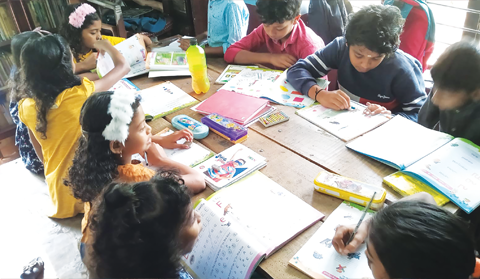
Resource repository is a treasury of resources in languages and Mathematics for our students and teachers. It included reading resources, teaching-learning materials to support the learning activities, teacher-training modules, activity worksheets, e-contents videos etc. that are prepared by different agencies like SCERT, DIET etc. and made available both online and offline. It also aims at providing additional materials to the DIKSHA portal. As part of implementing Kunnimani, a state level visioning workshop was conducted. Resource materials needed were collected and added to the repository. Kunnimani helped students, parents and teachers an easy access to additional teaching learning materials. The teaching learning process was made easier and more interesting. The resources and the worksheets helped to develop the language and numerical skills of learners.
PICTURE DIARY
The basic skill of writing of the learners of Grade 1 was enhanced using wide range of motor movement activities. The physical and motor development of the child ensured a positive self- concept among children. At the primary level, the children typically began to develop their drawing skills through simple activities such as drawing shapes, and colouring inside the lines. They then progress to draw basic objects, such as trees, houses and animals, before moving on to complex subjects like people and landscapes. Encouraging them to draw from life, such as observing and sketching plants and animals also was a useful way to develop their observational skills. They express their feelings and emotions using their simple vocabulary for describing the picture they have drawn with the help of their parents. Within a protective and enabling environment, children developed optimally. A state level visioning workshop was held on the first week of May, 2023 and a module was prepared. A picture diary was developed at a paper size of A4 in the workshop. By the end of the month, SRG, DRG and BRG were completed. A parental awareness was given at school level. The picture diary helped in the development and integration of the senses. It stimulated the intellectual curiosity and creative learning process. Independent writing skill and self-expression were developed in learners.
My Story Book Stories play a vital role in the holistic development of children. They can easily grasp words, phrases and usages while listening to stories which results in the development of language skills. The skill needs time and constant practice to develop. Focusing on the development of writing skills of students of primary classes, SSK implemented the programme My Story Book. This program enhanced their language skills, critical thinking and aesthetic sense. Module and assessment tools were developed at the State level visioning workshop. My Story Book was prepared using different pictures. SRG, DRG and BRG were conducted and the program was implemented in schools. Awareness on the program was given to parents. My Story Book helped in the creative learning process and self-expression of thoughts.
WORD WALL WORD WALL as an effective tool in the teaching learning process. A word wall is an organized display of vocabulary which is displayed in large visible letters on a wall bulletin board or any other display surface in a classroom. It serves as an excellent source of information for students attempting to analyse unknown words, spell unfamiliar words or define new vocabulary and foster word consciousness. It aimed at improving learner’s knowledge of words and their meaning in different contexts. The learners become morer confident in using vocabulary. The teachers of primary level were sensitised on the use of Word Wall in classrooms. The materials needed were developed in the workshops held. The orientation programmes for parents were conducted to ensure their support. The word wall improved the literary skill of learners and provided them with rich vocabulary.
‘Vayanachangatham’ – (A Programme For Enrichment of Reading And Creative Writing) (Grade 1to 5) Vayanachangatham is a programme envisaged to promote the habit of reading and creative writing of children in elementary classes. Samagra Shiksha Kerala envisaged Vayanachangatham as a process through which children steered to read and write with the support of parents. Vayanachangatham as a five year intervention, all classrooms, schools and homes will be equipped with libraries with books for children and parents. A visioning workshop was organised at the state level. Trainings were given at District and Block levels. Parents were sensitised about the program to ensure their support. Libraries were set up at class rooms and homes of learners. Vayanachangatham gave more opportunities for students in reading good books. Basic literary skills were developed in the learners by the time they complete Grade 5. Libraries with good reading materials were set up in class rooms, schools and homes. Students got opportunities to express their creativity and writing skills.
‘Smart Kids’ (Enhancing Language & Maths using Smart classrooms of 1 & 2) Smart class rooms are available in almost all primary classes in Kerala. Children like these classes very much. Making use of these smart classrooms, children in the early classes befriended the alphabets and numbers. Animated stories can be used in the teaching learning process. It helped the children to understand the language, alphabets, numbers and learning was made more interesting. In this way the numbers can also be introduced and practised. Basic skills of language and Maths developed to certain extent through these smart classrooms. A state level visioning workshop was organised. Prepared materials and try out classes were also taken in the SRG and BRG level training. BRC level orientation was given for the HMs and the SRG convenors. The program was implemented at the school level. The program made learning of language and maths in early classes more effective. Learners became confident in reading and writing. Teachers became more confident in handling classes using the smart classroom.
‘Smart Readers’ (Enhancing Foundational Language using Smart classrooms of 3 to 5) Smart class rooms are available in almost all primary classes in Kerala. Children like these classes very much. Making use of these smart classrooms, the children in the early classes befriended the alphabets. Developed the local texts in language (both in Malayalam and English) the teacher led the children to read the language by introducing the way of writing through this media. It helped the children to write the letters. In this way the numbers were also introduced and practised. Basic skills of language and Maths were developed to certain extent through this smart classrooms. A state level visioning workshop was organised. Prepared materials and try out classes were also taken in the SRG and BRG level training. BRC level orientation was given for the HMs and the SRG convenors. The program was implemented at the school level. The program made learning of language and maths in early classes more effective. Learners became confident in reading and writing. Teachers became more confident in handling classes using the smart classroom.
Read–Listen-Read (English/Malayalam) The intellectual skills of elementary level children are like a clean slate on which the foundation of future knowledge acquisition can be indelibly written. This is an age in which a lot of language acquisition happens. With an aim to provide opportunities for students to develop good accent and pronunciation, listen to proper English and Malayalam languages and to encourage independent reading, apart from text books, SSK introduced the program Read-listen Read. As part of these, colourful large print reading cards of 50-100 words were issued to children. They read the card and listen to the model reading played by the teacher. Reading aloud was encouraged and did activity worksheets. Reading and Listening skills of students were developed. Students were able to read the target language fluently with confidence. The learners were assured with good pronunciation skill with proper accent, stress and intonation. Fun filled learning made the children more interesting in reading and listening.
Classroom Library Programme (CLAP) A classroom library is a collection of books, magazines and other written resources within a classroom. It is an aggregation of age appropriate and class appropriate texts for the students in the class. A variety of genres can be included in the classroom library like fiction, fantasy, science fiction, biographies, autobiographies, myths and legends, fables, fairy tales, picture books, childrens’ magazine, picture cards etc. CLAP not only helped students learn about books and book selection but also provided more opportunities for children for independent and extended reading. Conducted state level and district level planning. Training was given for teachers to prepare classroom libraries. Piggy banks were provided for each class at the beginning of an academic year and the collected fund to buy books for the next year class room library formation. Portable hanging book shelves were provided in classrooms. In addition to the collection from piggy banks, a minimum amount of Rs.1000/- was allotted for each school depending on the number of divisions. Students contributed books to the class library .Children were provided diary to record the names of books they read. Digital text books and multimedia such as interactive whiteboard technology were used. Regular issuing and monitoring by teachers/students of books in the library were done. A library register was properly maintained.
KunjuEzhuthu (Little Scriptors) Books are the best companions of the readers. Writing provides numerous opportunities to develop children’s emergent literary capacities. It is a basic skill essential to achieve academic excellence. In order to improve the writing habits of children, books should be supplied to all children of STD 1 and 2. For this, pictorial worksheets with proper scaffolding hints related to the content and LOs are to be prepared and distributed among students. It develops the creative thinking capacity of children. State level visioning workshop was conducted and after that SRG,DRG and BRC level training were arranged. Worksheets were prepared and distributed. Opportunities were provided for students to express their creativity. They became independent writers and their writing skills got promoted.
Hello English English has been considered as the first Global Lingua Franca. In this world of globalisation, there is an urgent requirement for the mastery of a common language in which all the data and information are available. That is where the world of today needs English – Our students need English – Let’s catch them young. State level visioning workshops were conducted. TLM and modules were prepared. 20 story books were given to schools as part of HELLO ENGLISH. Through the programme, the basic language skills of students in English were developed. Apt opportunities were provided to children in using English language.
Malayalathilakkam for class 1 to 5 Malayalathilakkam is implemented as part of the General Education Rejuvenation Mission. The programme helped students to become independent readers and writers suited to the level of their schooling in their mother toungue. The remedial support for students who struggle with reading and writing was given by tapping their creative potentials to read, draw, write and perform. Even though students succeeded to a very high extent in reading and writing, some students failed to construct various discourses demanded by the curriculum at class specific level considering all the micro indicators of the discourse. It equipped all students to construct various discourses such as description, stories, poems conversations, notes, script, screen play, slogan, poster, letter, character sketch, appreciation, diary, etc. at class specific level considering all the suggested indicators. A state level workshop was conducted and prepared activity package and suitable resources including audios, videos and print. Empowerment programmes were organised including resource persons at state and district level and finalised the activity package. Teacher empowerment programme at cluster level was conducted. Collected and prepared varied reading materials and elaborated the class library. Creative workshop for students, parents and members of the community for the development of varied local texts and discourses were done. Creative writing skills of children were improved and their reading skills got enhanced. They got ample opportunities to interact with the experts.
Joyful Reading Kids - KunjuVayana Reading is a cognitive process of decoding symbols to derive meaning. It is a form of language processing. Success in this process is measured as reading comprehension. Reading is a means for language acquisition, communication, and sharing information and ideas. A print rich atmosphere is created in the classroom and a variety of age specific and class specific reading materials are developed. An emotional attachment towards the reading materials by involving students, parents and community in material development was created. A State level workshop for developing the design and guidelines for schools was organised. The orientation for teachers at district level and orientation of parents at school level were organised. Printing of multi-coloured reading cards and setting up of Class library was done. Programme was assessed at school level / district level/ state level. All the learners of class I & II became independent readers. Reading materials were always accessible to learners. Learners showed interest in reading, participated willingly in tasks connected with reading and undertook writing tasks. Learners read books of their choice for different purposes. Learners applied the reading skills to comprehend the learning tasks set for them. The parental co-operation helps the revival of reading habits of parents. Parents and society became active in school activities.
FOUNDATIONAL NUMERACY
Let’s Measure Measurement is a skill needed in day to day lfe. But it raises problems for many children as it requires the recognition of attributes which may not yet have become the conscious part of a child’s experience. Students learnt basic measurement concepts and its application such as length, area, volume, mass, time, money, temperature etc. State level workshop on module preparation (2 days) was organised. Preparation of activity package and TLM was done. Students became familiar with the basic measurement concepts like length, area, volume, time, money, temperature etc. and their application. Students experienced these concepts by comparing the attributes. Students were able to do practical measurement activities by themselves.