
Free Textbook
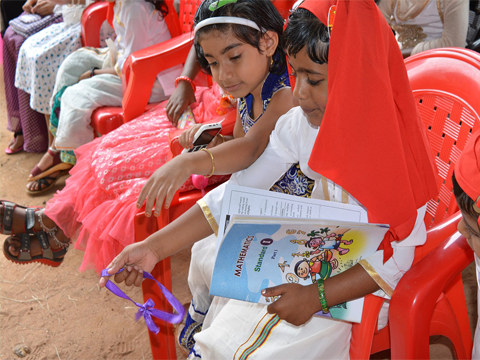
Text book is inevitable in teaching-learning process which ensures free and quality education to students between ages of 6 to 14 as per the Right to Education. Text books were distributed free of cost to all children from Standard 1 to 8 as part of ensuring compulsory and free education. This intervention ensured the availability of textbook on time. Before the distribution of text book, the required number of text books was collected. Books were distributed at the beginning of the academic year. It was distributed in two volumes meant to lessen the burden of carrying bulky text books.
Free uniform
In every stage of education, Government and society supported the marginalised as well as the socio-economically backward learners. By providing free uniforms to all girls from class one to eight and to all boys belonging to BPL, Scheduled Castes and Scheduled Tribes, student attendance in school was ensured. As part of the intervention, the most deserving students were identified and free uniform were distributed through schools. This intervention was able to foster a sense of solidarity and oneness in learners. It generated a sense of belonging, pride and loyalty towards the school. This helped to mainstream the marginalised students. The financial burden of the parents for purchasing uniforms were lessened through this.
Out of school children
As per the provisions of the RTE Act, efforts are being made to identify and ensure education to children who are not enrolled or who do not continue their education after enrolment. The backwardness of the students in academics were addressed as they couldn’t reach up to the level of their peer group. Students who hailed from coastal, remote, immigrants and tribal areas witnessed such social and academic backwardness. Such students are brought to the main stream of society by ensuring them with the basic skills. As a pilot programme, one division from class 2 to 5 from five panchayats were selected in each district. Pre-tests in language and maths were conducted and prepared bridge materials. A 20 hour programme on the basis of skill development activities was conducted. Based on the post test, extra activities were given. A prior importance was given to children who failed regular attendance and had learning gaps. Holistic development of children were ensured through the attainment of grade level learning outcomes. Activity oriented learning created among children to involve in the classroom processes.
Community Mobilization and Media (Elementary and Secondary)
Education is a socialisation process. Social support and social co-operation are essential to ensure quality education to learners. This will enable the learners to develop a feeling of social well being. Activities under this area are initiated with the objective of ensuring social support to children between the age of 6 and 14 years.
Pravesanolsavam (Elementary & Secondary)
School opening in the beginning of the academic year is celebrated as Pravesanolsavam. It is organized in all the schools with the objective of bringing all the eligible children to schools as per the Right to Education Act and making the school environment child friendly. The school and its surroundings are beautifully decorated and the children are given presents and sweets to make the first day in school memorable and happy. This helps the children to easily adapt to the school atmosphere. BRC level and school level programmes are conducted in the presence of LSG members and educational officers. It helps to make the social environment child friendly. The students who are already in schools also get rejuvenated. It praves the way for the public to get awareness about the excellence of schools. As the first step in conducting Pravesanotsavam, convergence meeting and PEC was conducted SMC trainings were also conducted. School and surroundings were made attractive. Newcomers were welcomed to a free, colourful, jovial atmosphere public gets an awareness on the merits of general education. Public got an awareness about the merits of general education. Rate of enrolment in schools under general education increased. Social support to schools was ensured. Involvement of parents and support of Local Self Governing bodies were also ensured.
Panchayth Education Committee (PEC)
Panchayath Education Committees, which improved the standard of school education from Std 1 to 12, was formulated as a part of the Central Govt. Scheme Samagra Shiksha Kerala (SSK). All LP, UP schools of a Panchayath comes under this committee. All HM’s are members of PEC, chaired by Panchayath President and Education Standing committee chairman, as vice chairman. Apart from them, all Ward members, PTA, MPTA members, Health inspectors, Saksharatha mission officer, CDS chairman, ICDS supervisors, Representation of parents of differently abled students, Teachers and Student’s union representative, Aided school management representative, Educational experts, BRC members also form members. PEC is regularly conducted in all months and every decision taken in the committee shall get implemented in schools. Monthly reports of schools including evidences shall be presented in PEC’s by the respective HM’s. Education becomes a social process. Academic and physical status of schools gets support financial support from LSGs a was ensured. PEC gets conducted every month. In the PEC the head of the school presents the activities of a school during a month. An activity calendar is exhibited highlighting the upcoming events. Panchayat level annual work plan of schools gets consolidated. Infrastructure facilities are ensured. High achievement level of schools are ensured. Schools got public support and empowerment from elected representatives of LSGs possibilities of improvisations got highlighted.
Padanolsavam
Every schools are being upgraded both academically and infrastructurally to provide quality education to children. The academic excellence attained by the schools are shared with the society in order to get support and co-operation. The parents feel honoured and the public gets an awareness of the activities that are going on in the school under general education. Padanolsavam is conducted in the elementary and secondary levels to exhibit the achieved skills and excellence of the students of public schools. The programme attracted attention of parents and public. The activities in schools are socially evaluated. The confidence level of learners was boosted up. The important phases in conducting padanolsavam are convergence meeting of educational officers and district level training of resource persons. Then module preparation and familiarisation of module to HMs and SRG convenors was conducted. Then special SRG meeting at school level was conducted along with SMC and PEC meetings. At the end with the support of society, padanolsavam was conducted. The excellence of general education was brought to limelight Academic activities for the next year was planned and presented. The relationship between teachers and parents gets strengthened. The progress of school and students are supported through local resource. Parents also get strengthened.
Class PTA (Elementary and secondary level)
Class PTA has a great role in creating a healthy atmosphere to ensure that all students attain academic excellence. Class PTA can give support to a teacher to understand the strength and limitations of each student. Proper communication and interaction between teacher and the parent make the school environment healthy and excellent. The relationship between teachers and parents gets strengthened. The progress of schools and students are supported through local resource. Parents also get strengthened. Guidelines were prepared through guideline preparation. Guideline was familiarised. Empowerment of HM & SRG at district and BRC level. Parents supported children by recognising their strengths and limitations. Academic level of each and every student is ensured. The relationship between parents and teachers became healthy. The relationship between school and society was strengthened.
Training SMC/SMDC
It is important to make awareness to parents in involving in academic activities in school. Facilitated the role of parents in general education. Parents gets an awareness on learning outcome learning enhancements, abilities etc.